
7 November 2026 · 7 min read
What to expect from a free in-home care assessment
There's a particular kind of dread that comes with the words "someone needs to come and assess you." Maybe it's the memory of a hospital discharge meeting that felt rushed and clinical. Maybe it's picturing a stranger on your doorstep with a clipboard, ticking boxes about things you'd rather not discuss with anyone, let alone someone you've just met. For a lot of people in Cairns and the surrounding suburbs, the idea of inviting an unfamiliar face into their lounge room — to look around, ask questions, and quietly form an opinion about how you're coping — is enough to put the whole idea of getting help in the too-hard basket. If that's where you're at, you're not alone, and it's worth unpacking exactly why that fear is so common, and so sticky.
Why "assessment" is such a loaded word
For most families, the first time the word "assessment" comes up is in the context of aged care funding — and that context sets the tone for everything after. It usually arrives at a stressful moment: after a fall, a hospital stay, or a GP raising concerns during a check-up. By the time someone mentions "you'll need to be assessed," the family is often already anxious, and the word itself starts to carry weight it probably shouldn't.
Part of the worry is about intrusion. People picture being asked detailed questions about toileting, bathing, memory lapses or money troubles, by someone taking notes on a form, in front of a partner or adult child who might not know the full picture. There's a very human fear of being judged — of an assessor silently deciding "this person can't cope anymore" and that judgement somehow being out of your control. Nobody wants to feel like they're being marked on how well they're managing their own life.
Then there's the uncertainty. Most people have no real idea what will actually be asked, how long it will take, or what happens to the information afterwards. Will it go into some government file? Will it trigger more appointments, more phone calls, more waiting? And underneath all of that sits a quieter worry: that agreeing to "an assessment" is really just agreeing to a sales pitch in disguise — that someone will turn up, look for problems, and then try to sell you a package of services you didn't ask for and aren't sure you need. When you put intrusive questions, feeling judged, long bureaucratic delays and a fear of being upsold all in the same basket, it's no wonder so many older Cairns locals and their families put off making the call for months, sometimes years, longer than they probably should have.
What people usually try, and where it falls short
If you want government-subsidised home care — the kind that comes through a Home Care Package — there's no way around the formal pathway. You, or a family member, call My Aged Care, answer some initial screening questions, and wait to be referred for a proper assessment with a qualified assessor. That process exists for good reasons: it's thorough, it's consistent, and it's how funding gets allocated fairly across the whole country. But "thorough and consistent" also means slow and clinical. Waits for an assessment appointment can stretch for weeks, the assessor is a stranger doing a job they do dozens of times a week, and the conversation is necessarily structured around forms and funding categories rather than around you as a person. It's not built to be warm — it's built to be defensible, auditable, and fair across a huge population. For many families, that formal process is simply necessary, and it's worth persevering with if you want access to subsidised support. But it rarely feels like the first step should feel: reassuring.
The other option people consider is going private — paying for care directly rather than waiting on government funding. On paper this sounds simpler and faster, and it often is. But here's the catch: most people have never dealt with a private home care provider before, so they genuinely don't know what to expect from that first contact either. Will it be a hard sell over the phone? Will someone turn up in a branded polo shirt with a sign-up pack already printed? Will they be pressured into a long-term contract before they've even worked out if they like the carer? Without a clear picture of what "calling a private provider" actually involves, people often default to doing nothing — not because the formal pathway is appealing, but because the alternative feels just as murky.
What actually happens when Home Care Mate visits
This is exactly the gap we built the "cuppa and a chat" around. There's no referral needed, no My Aged Care portal to navigate first, and no waiting list before someone will even talk to you. You call us, or fill in a short form online, and we arrange a time that suits — often within days, not weeks.
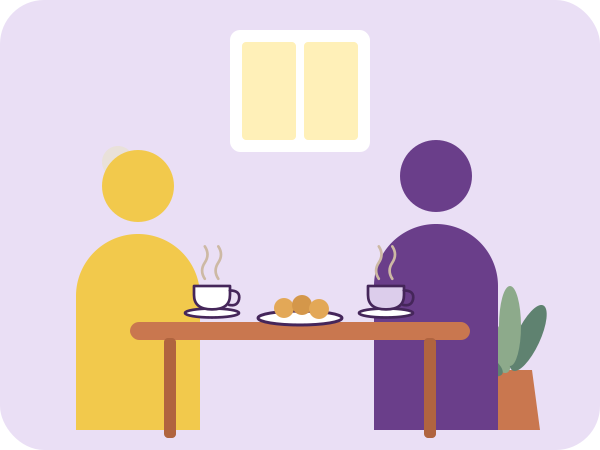
When we visit, it's genuinely informal. One of our directors or a care coordinator comes to your home, sits down at your kitchen table, and has a conversation over a cup of tea. There's no uniform, no clipboard thrust in front of you, no form being filled in while you talk. It's a conversation first, and any notes come later.
The topics we cover are practical and led by you, not by a checklist designed for funding categories. We'll talk about your daily routine — what a good day looks like, what time you like to get up, what you enjoy doing, and where the sticking points are. We'll ask what kind of support would actually make a difference: that might be company and conversation, help with housework, personal care, transport to appointments, or a combination. We'll gently cover any health or mobility notes that matter for keeping you safe and comfortable, but only as much as is relevant and only at your pace. We'll ask who else should be part of the conversation — a partner, an adult child, a GP — because care decisions usually involve more than one person, and we'd rather that be out in the open than guessed at. And we'll ask about your preferences for who visits and how often, because the whole point of private care is that it can flex around you, rather than you flexing around a system.
What happens afterwards is just as important as the visit itself. We put together a simple, written care plan along with clear, upfront pricing — no vague ranges, no fine print you need a lawyer to decipher. You take that away and think it over. There's no pressure to sign anything on the day, and no follow-up calls chasing you for a decision. If and when you're ready, the next step is being matched with a carer whose personality and skills suit you, not just whoever happens to be free that week.
The short version
The two biggest things that keep people from reaching out for help are the fear of bureaucracy and the fear of being pressured into something before they're ready. The formal aged care assessment pathway is important, and sometimes unavoidable, but it was never designed to put anyone at ease. Our free cuppa and chat was designed to do exactly the opposite: a relaxed, unhurried conversation in your own home, with no referral required and no obligation at the end of it. You get clarity on what support could look like and what it costs, without having to hand over control of the process to a stranger with a form.
If you'd like to book your own free cuppa and chat, get in touch — we'd love to meet you.
Book a free cuppa & chat